


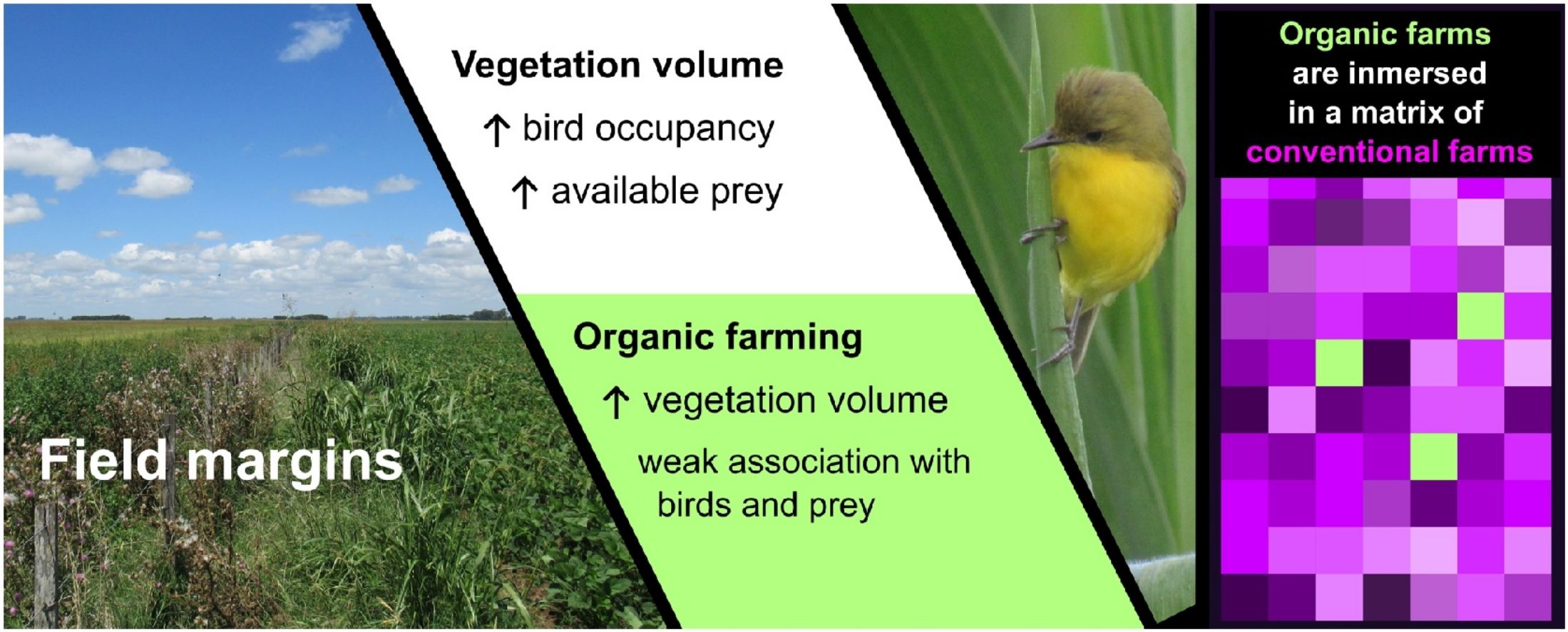

Several studies have concluded that alternative farming regimes (e.g., organic), and the maintenance of field margins benefit farmland birds, and that this positive association is stronger in simple landscapes (i.e., characterized by a high proportion of arable land and a low proportion of semi-natural habitats). However, studies tend to be biased toward certain geographic regions with smaller and more heterogeneous farms. Agroecosystems in Argentina are particularly homogeneous, with large arable fields and sparse uncultivated field margins. Moreover, only 0.55% of the agricultural area is devoted to organic farming. Our aim was to assess the relationship between passerine bird occupancy and farming regime (organic/conventional) in field margins of large-scale, intensively managed agroecosystems in central Argentina during spring and summer. Also, we evaluated the influence of herbaceous vegetation of field margins (measured as vegetation volume) in both farming regimes on bird occupancy. Additionally, we aimed to determine whether insectivorous gleaners’ occupancy varied with prey availability. Our findings indicate that vegetation volume in field margins enhances both bird occupancy probabilities and prey availability, regardless of the farming regime and season. We also found that the association between the bird community and organic farming was weak, although it appeared to be stronger during summer. Organic farming was negatively associated with five bird species and positively with two. This weak influence of organic farming may be related by the relatively small surface of organic farming and the fact that organic farms are embedded within a matrix dominated by conventional farming.
Efforts to develop conservation strategies in agroecosystems are increasing (Quinn et al., 2012), and several management strategies have been proposed to mitigate the negative effects of agricultural intensification on biodiversity, including birds (Batáry et al., 2010; Chamberlain et al., 1999; Kirk et al., 2020; Kragten and de Snoo, 2008). One such strategy involves implementing alternative farming regimes, such as organic farming, which excludes pesticides, among other practices (Ramakrishnan et al., 2021). Another conservation strategy is the maintenance of field margins, which provides suitable habitat for several farmland bird species (Newton, 2017; Vickery et al., 2009). However, the quality of field margins for birds depends on their physical characteristics and vegetation structure (e.g., length, height, width, vegetation volume), as well as on the availability of arthropod prey for insectivorous birds (Douglas et al., 2009; Goijman and Zaccagnini, 2008; Goijman et al., 2020).
In conventional farms, the use of agrochemicals negatively affects habitat quality for birds by reducing the arthropod food supply and altering vegetation structure of margins (McKenzie and Whittingham, 2009; Newton, 2017). Even when margins on conventional farms are not intentionally sprayed, the drift of insecticides and herbicides from adjacent fields can still impact on vegetation structure and food availability (Boutin and Jobin, 1998). Thus, field margins in organic farming tend to preserve better habitat quality than those under conventional farming (Chamberlain and Wilson, 2000). The implementation of organic farming together with field margin maintenance may play a key role in avian conservation; however, most studies come from Europe and North America (Batáry et al., 2010; Douglas et al., 2009; Quinn et al., 2012), where farms, particularly in Europe, are smaller than those in Argentina, which are typically large-scale and characterized by more homogeneous agricultural landscapes. In Argentina, Goijman et al. (2020) found that certain arthropods available to birds as prey reached their highest abundances even after insecticide applications in conventional farms. Yet, no previous study has compared the arthropod availability as prey for birds between the two farming regimes. Arthropods constitute an important dietary component for several bird species, ensuring nestling growth and survival. Consequently, conservation efforts to restore agricultural insectivorous bird populations also focus on preserving habitats that provide abundant arthropod resources during the breeding season (Douglas et al., 2009).
Despite some studies that evaluated the effect of field margin characteristics on birds in conventional farms in Argentina (Depalma and Mermoz, 2019; Depalma et al., 2022; Di Giacomo and Lopez de Casenave, 2010; Goijman et al., 2020), there are no studies in Argentina or Latin America comparing field margins in large-scale conventional and organic farming. Previously, in a landscape-scale study, Contreras et al. (2022) observed that the influence of organic agriculture on farmland birds in Argentina was variable, benefiting some insectivorous and omnivorous species. In that study, the authors evaluated the influence of farming systems (organic or conventional) on the occupancy of the farmland bird community, and assessed how the proportion of the dominant annual crops (soybean, maize, wheat, sunflower, and others) influenced occupancy probabilities. However, their analyses included all farmland bird species using both arable plots and field margins. This approach overlooks the substantial differences in the spatial scales at which some species as carnivores (raptors), omnivores, granivores (doves, pigeons, and the monk parakeet), and some insectivores perceive the landscape (Goijman et al., 2015). For this reason, in this study we focused on the local scale of field margins, which constitute a key habitat for passerine birds in agroecosystems. Specifically, our aim was to evaluate the influence of organic and conventional field margins on passerine occupancy in farms embedded within large-scale, intensively managed agroecosystems of central Argentina during spring and summer. To achieve this, we assessed the association between field margin vegetation under both farming systems and passerine occupancy. In addition, we evaluated whether the occupancy probabilities of a subset of passerine birds classified as insectivorous gleaners (i.e., insectivorous species that feed by picking arthropods from the surface of vegetation and other nearby substrates) varied with arthropod prey availability in the field margin across management types. We focused specifically on insectivorous gleaners because arthropods were sampled by sweeping the vegetation along field margins, a method that primarily captures arthropods occurring on vegetation. Thus, this sampling approach provides a more direct measure of the potential prey available to birds that predominantly glean arthropods from vegetation and other nearby substrates than to insectivorous birds using other foraging techniques. We hypothesized that habitat quality (measured as vegetation volume and arthropod abundance) is higher in organic than in conventional field margins. Consequently, we expected passerine species, particularly insectivorous gleaners, to exhibit higher occupancy probabilities in organic field margins.
Material and methodsStudy areaThe research was conducted in an intensively managed agroecosystem in south-eastern Córdoba province, Argentina (Appendix A - Fig. A1). This region is part of the Pampas ecoregion, originally dominated by natural grasslands, but is currently embedded in an agroecosystem where part of the original flora is restricted to uncultivated field margins. The area is dominated by conventional agriculture, with farms larger than 1000 ha and extensive arable plots (Bedano and Domínguez, 2016). The most common annual crop rotations include wheat–soybean or soybean–maize. In Argentina, there are 36 Mha under conventional farming (Aapresid, 2018), with only 3.6 Mha under organic farming. Most of this area is devoted to livestock pastures, whereas only 6% is used for crop production (SENASA, 2019). In this area, only three farms practice certified organic agriculture (Argencert, 2018; OIA, 2017), and are comparable in size to conventional farms: “Las Dos Hermanas” practices organic agriculture and has a natural grassland reserve, while “Las Gaviotas” and “Altos Verdes” practice both organic and conventional farming. We also included a fourth farm in the study, “El Chañarito”, which practices only conventional agriculture (for details, see Appendix A - Table A1). Our study included the entire surface of organic farms in south-eastern Córdoba province.
The arable plots at Las Gaviotas and Altos Verdes have been managed under organic practices for more than a decade, whereas Las Dos Hermanas has been exclusively managed under organic agriculture throughout its history. In organic farms, weeds are controlled mechanically using disk and chisel plough, roll and weeder, while conventional farms rely on herbicides such as glyphosate, atrazine, acetochlor, nicosulfuron, 2−4-D, chlorimuron and metolachlor. Conventional plots also regularly receive external inputs, including fertilizers and insecticides such as chlorpyrifos, alphamethrin, cyclopropane carboxylate, endosulfan, and lambda-cyhalothrin (Coda et al., 2015).
The study was conducted along field margins in organic and conventional agricultural fields. Field margins were defined as the strips of vegetation located along the boundaries of arable plots, typically 1.5–2 m wide (Coda et al., 2014). Only permanent field margins delimited by fences were included in the study. Field margins adjacent to roads were excluded because they are typically wider and differ structurally from those separating arable plots. In the study region, field margins are composed primarily of a mixture of native and non-native herbaceous species (Gomez et al., 2018). To minimize bias, we focused on field margins characterized by herbaceous vegetation and excluded those containing shrubs or trees (Appendix A - Fig. A2).
Over the last three decades, the widespread adoption of the technological package based on Roundup Ready soybean and no-till farming has substantially altered the landscape configuration of these agroecosystems. This process has promoted the consolidation of larger arable plots, resulting in a reduction in the total length of field margins across the landscape. Because the organic and conventional farms included in this study were similar in plot size, the perimeter/area ratio of arable plots was slightly higher in organic than in conventional farming systems (0.0096 m/ha in organic farms and 0.0086 m/ha in conventional farms) (Serafini, 2020).
BirdsBird surveys were conducted at sampling points located within field margins from 2016 to 2018 during two austral breeding seasons, in spring and summer. We surveyed a total of 310 sampling points, including 154 in organic farms and 156 in conventional farms. The number and location of sampling points varied between breeding seasons (Appendix A - Table A2). Points were located along field margins and randomly selected for each breeding season using QGIS 2.7 (QGIS Development Team, 2017). Points were spaced at least 400 m apart and 200 m from field boundaries to ensure independence and minimize potential chemical contamination from adjacent conventional fields.
Following Goijman et al. (2020), we only recorded passerine birds seen or heard actively using the field margin (e.g. we did not consider birds flying or using adjacent plots) during 5 min, in points surveys covering a distance of 25 m on each side along the field margin. Surveys were conducted between 0600–1100 and 1600–2000.
To investigate how bird species respond to arthropod prey availability in field margins under both farming practices, we focused on a functional group rather than on the entire assemblage, because bird species differ substantially in the spatial scale at which they perceive and respond to landscape features (Remsen and Robinson, 1990). Given that our arthropod samples consisted of aerial and foliage arthropods obtained by sweeping the upper vegetation of the field margins, we focused on insectivorous gleaners, for which this sampling approach provides a more direct measure of potential prey availability than for insectivorous birds using other foraging techniques. Following Goijman et al. (2015, 2020), we initially included passerine species belonging to the families Tyrannidae, Furnariidae, Troglodytidae, and Emberizidae (taxonomic criterion). We then retained only species that meet three criteria: (i) invertebrates constitute an important component of their diet during the breeding season, (ii) their main foraging substrate is foliage and other nearby substrates, and (iii) they feed by picking arthropods from these substrates. Information on diet, foraging strategy, and primary foraging stratum was obtained from Billerman et al. (2026), de la Peña (2015), and field observations.
VegetationAt each bird survey point, vegetation was measured in three sampling points using 1 m2 quadrats placed on the field margin. Vegetation volume (m3) was estimated in each quadrat unit as the product of shelter and height. Shelter was determined by combining the surface area of green cover and plant litter (m2), while height was the average value of green cover and plant litter randomly registered within the quadrat. Measurements of the three quadrats were averaged to obtain a unique value of vegetation volume per bird survey point (Coda et al., 2015).
Prey availabilityArthropod abundance in field margins was considered an indicator of prey availability (Goijman et al., 2020; Johnson, 2007; van Vliet et al., 2020). Arthropods were sampled at the bird-survey points along field margins. Following the methodology of Goijman et al. (2020) and van Vliet et al. (2020), sampling was conducted between 1100–1600, when temperatures and arthropod activity are the highest (Hill, 1980). We used a sweep net to collect aerial and foliage arthropods by sweeping the upper vegetation at each point along the field margin. This was done for 2 transects of 25 sweeps each, that were pooled afterwards, moving in opposite directions from the bird sampling point, covering approximately 25 m per transect.
Samples were stored in 70% alcohol for posterior taxonomic classification. Following Goijman et al. (2020), who also focused on arthropods as prey for birds, we identified, classified and counted arthropods by Class Arachnida and insects to Order level: Coleoptera, Hemiptera, Diptera, Hymenoptera, Orthoptera, Lepidoptera, Odonata, Neuroptera, and unknown (loose body parts and damaged arthropods that could not be identified). Coleoptera, Lepidoptera and Neuroptera were distinguished between larval and adult stages. Before drying the samples at ambient temperature for 72 h, biomass (g) was recorded for each classified arthropod (digital scale, 0.0001 g). Spearman correlation analyses were performed to test for multicollinearity among arthropods biomass and abundance, which resulted correlated (p < 0.05) choosing to use abundance (Appendix A - Table A3).
Occupancy analysisWe used hierarchical multi-species and multi-season occupancy models under a Bayesian approach based on detection/non-detection data (Kéry and Royle, 2016; Royle and Dorazio, 2008).
We modified the model proposed by Contreras et al. (2022) and Kéry and Royle (2016) to incorporate year t and farm f as a random effect. We built one model to estimate occupancy of all species observed in field margins (Model 1), and another for insectivores gleaners (Model 2):
In both models β0 is estimated for each species i, farm f and year t; farming, vveg, season and prey correspond to farming (organic in relation to conventional), vegetation volume, season and prey availability of each point survey j, farm f and year t respectively.
We made inferences based on 95% Bayesian credible intervals (95% CRI). If the zero was not included in the 95% CRI, we considered it a strong effect, but also considered a weak effect when up to 5% of the posterior distributions had a different sign than the mean (i.e. f > 0.95).
We constructed the observation (detection) model (model 1 and model 2) as follows:
where we estimated the effect of time of day on detection for each species i, ɑ0 is estimated for each species i and year t; and time corresponds to the hour of day (minutes from 0600) of each point survey j, repetition k, farm f and year t. We included time of day as covariate because it influences bird detection probability (Morelli et al., 2022).
We used a Generalized Linear Mixed Model (GLMM) with a Poisson distribution to estimate the relationship between prey availability and vegetation, farming management, and season:
ⲁ0 is estimated for each site j, farm f and year t; vveg, farming and season correspond to vegetation volume, farming and season of each point j, farm f and year t respectively.
To find the posterior distribution of the parameters of interest we ran three chains of length 300,000 each, discarding the first 150,000 as a burn in, with a thinning rate of ten. We used weakly informative priors for all parameters (Appendix B). We assessed convergence by visual inspection of the chains and using the Gelman and Rubin diagnostic (Gelman and Rubin, 1992). We ran the analyses in R 3.1.2 (R Development Core Team, 2018) through package jagsUI (Kellner, 2016).
Because our objectives and hypothesis concern the association between occupancy and farming regime, vegetation volume and prey availability, we report the posterior means of the covariate coefficients (logit scale) at the community and species levels. These coefficients are directly comparable among species regardless of their baseline occupancy.
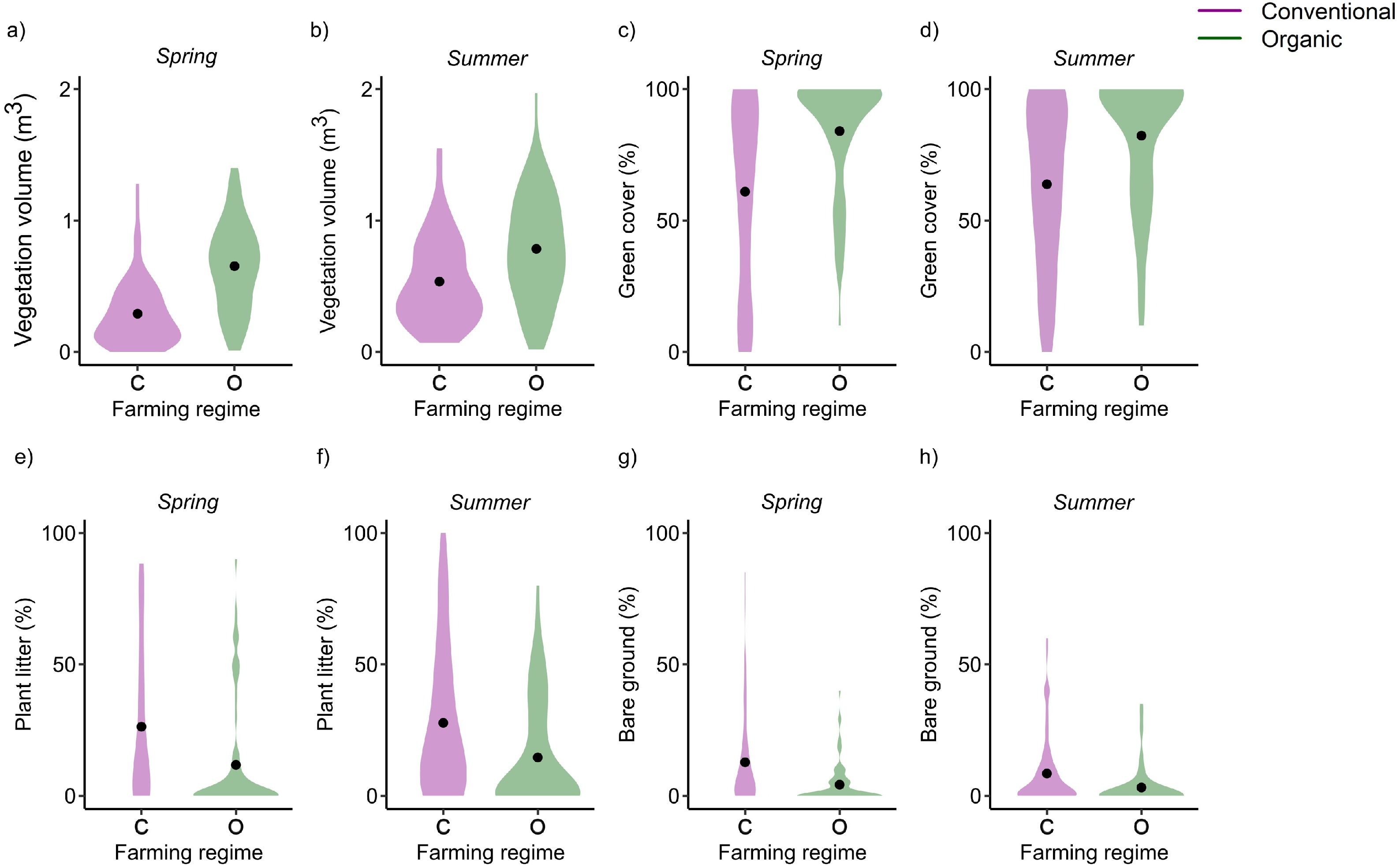
ResultsVegetation and preysVegetation volume was higher in field margins under organic than in conventional farming, reaching the highest volumes in the first (Fig. 1a, b). In organic farms, vegetation volume was mainly composed of green cover (Fig. 1c, d), whereas in conventional farms we registered the highest plant litter and bare ground cover in both seasons (Fig. 1e–h).
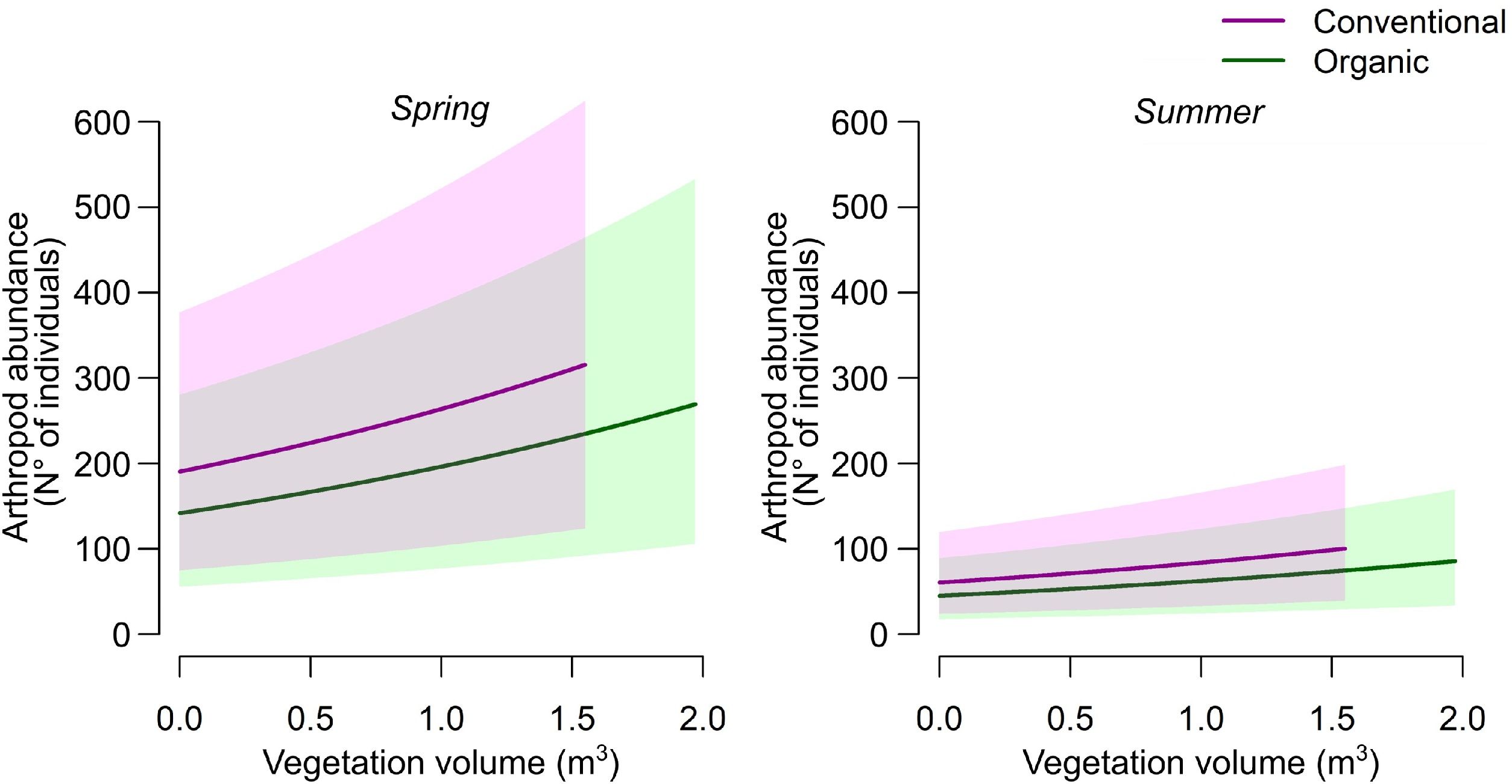
Arthropod abundance increased with vegetation volume (ɑ = 0.326; 95% CRI = (0.310, 0.342)), was slightly higher in conventional than organic farms (ɑ = -0.296; 95% CRI = (−0.320, −0.272)), and during the spring season (ɑ = −1.146; 95% CRI = (−1.210, −1.083)) (Fig. 2). The orders Coleoptera (in their adult stage) and Hemiptera (during spring) were the most represented (Appendix A - Table A4).
BirdsWe observed 35 bird species using field margins, including 10 insectivorous gleaners (Appendix A - Table A5). Detection probability decreased in relation to time of the day, and was higher in the morning (Appendix A - Fig. A3).
For the entire field margin community (Model 1, n = 35 bird species), organic farming was weakly negatively associated with occupancy (community mean effect, β = −0.266; 95% CRI = (−0.688, 0.143)), and on Pseudocolopterix sp. and Zonotrichia capensis; but had a weak positive effect on Tyrannus savana and Anumbius annumbi (Fig. 3a). On the other hand, vegetation volume was strongly positively associated with occupancy (community mean effect, β = 0.519; 95% CRI = (0.349, 0.692)) and with all bird species (Fig. 3b). Regarding the seasons, summer was strongly negatively associated with occupancy (community mean effect, β = −0.773; 95% CRI = (−1.127, −0.434)) (Fig. 3c). We did not observe an interaction effect between organic farming and vegetation volume (community mean effect, β = −0.070; 95% CRI = (−0.291, 0.146)), but found a positive association between the interaction of organic farming and summer and occupancy (community mean effect, β = 0.450; 95% CRI = (−0.041, 0.949)), and on T. savana, Furnarius rufus, A. annumbi, Agelaiodes badius, and Sicalis flaveola (Fig. 3d). For details on species-specific coefficients, see Appendix A - Table A6.
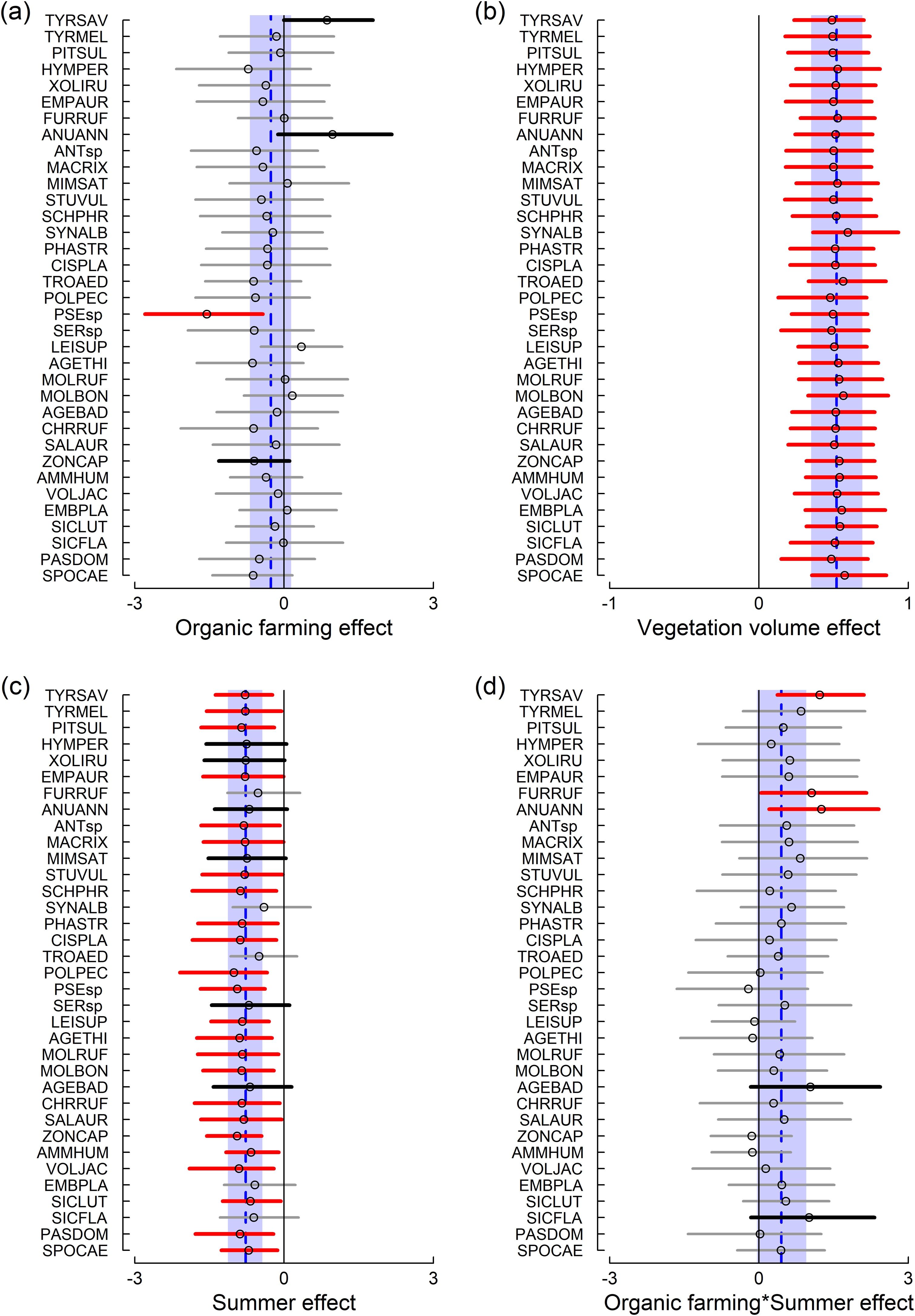
Effect of each covariate on logit occupancy (logitѰ) of each field margin community bird species (n = 35 species) (posterior means of the coefficients in the logit scale and 95% CRI). a) organic farming (relative to conventional); b) vegetation volume; c) summer season (relative to spring season); d) interaction between organic farming (relative to conventional) and summer season (relative to spring season). Solid red lines, 95% CRI that do not overlap zero. Solid black lines, 95% CRI that slightly overlap zero. Vertical solid blue line: mean community effect (logit scale); shaded area: 95% CRI of community mean effect.
For insectivorous gleaners (Model 2, n = 10 bird species), organic farming was strongly negatively associated with occupancy (community mean effect, β = −0.923; 95% CRI = (−1.516, −0.337)), and with five species (Fig. 4a). Prey availability was not associated with avian group occupancy (community mean effect, β = 0.122; 95% CRI = (−0.241, 0.437)), but we found a strong positive association with Polystictus pectoralis (Fig. 4b). Similarly to Model 1, vegetation volume was positively associated with occupancy of all species (community mean effect, β = 0.650; 95% CRI = (0.387, 0.897)) (Fig. 4c), and summer was strongly negatively associated with occupancy of the group (community mean effect, β = −0.855; 95% CRI = (−1.490, −0.270)) and on seven species (Fig. 4d). The interaction between prey availability and organic farming was not associated with occupancy (community mean effect, β = −0.263; 95% CRI = (−0.715, 0.148)). For details on species-specific coefficients, see Appendix A - Table A7.
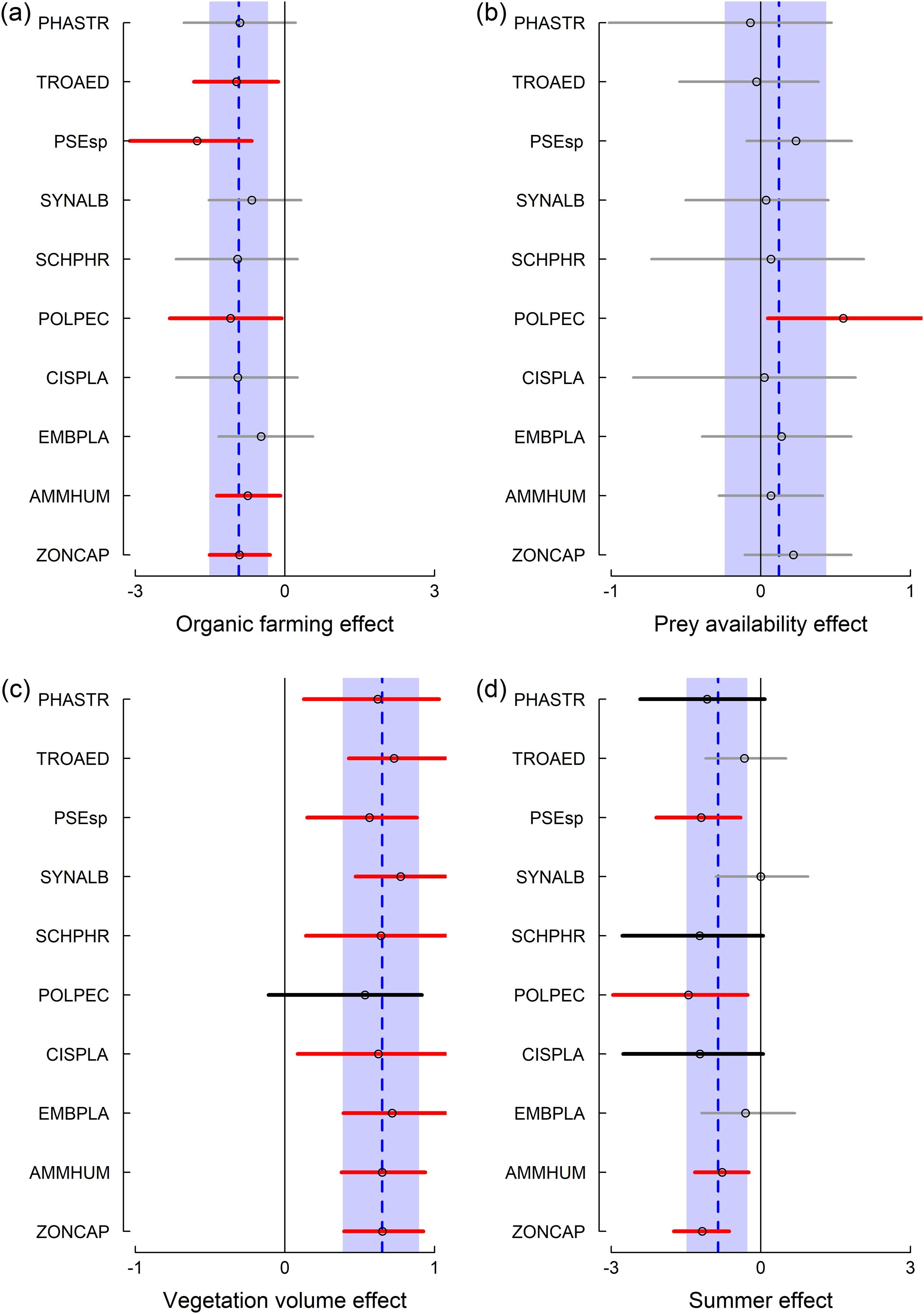
Effect of each covariate on logit occupancy (logitѰ) of field margin insectivorous gleaners (n = 10 species) (posterior means of the coefficients in the logit scale and 95% CRI). a) organic farming (relative to conventional); b) prey availability; c) vegetation volume; d) summer season (relative to spring season). Solid red lines, 95% CRI that do not overlap zero. Solid black lines, 95% CRI that slightly overlap zero. Vertical solid blue line: mean community effect (logit scale); shaded area: 95% CRI of community mean effect.
Vegetation volume plays a key role in the occurrence of birds using field margins in intensive agroecosystems in Argentina. Moreover, it increases arthropod abundance, which potentially serves as prey for insectivorous birds, although we were not able to demonstrate a strong association between preys and birds in this study. Our findings agree with previous studies that indicate the positive influence of field margin vegetation on birds (Batáry et al., 2010; Di Giacomo and Lopez de Casenave, 2010; Filloy and Bellocq, 2007; Codesido et al., 2013; Goijman et al., 2020). Other linear habitats, such as roadsides, have also been shown to enhance bird abundance and richness (Depalma et al., 2022). In general, these linear habitats consist of herbaceous vegetation, shrubs and/or trees, which provide greater vegetation structure and therefore benefit birds. However, in our study we focused on crop field margins located within agricultural fields, not adjacent to rural roads. These internal field margins are typically narrower than roadsides and are composed solely of herbaceous vegetation. As predicted, the vegetation volume was higher in organic field margins than in conventional ones. However, the strong positive association between vegetation and birds appears to have been the primary driver, explaining why we did not detect an additional interaction with the management type.
Contrary to our expectations, we found a weak association between organic farming and the occupancy of the bird community using field margins. However, its association was context-dependent: occupancy probability tended to be higher in organic farms during summer, as indicated by the positive interaction between organic farming and season. One possible explanation is that, during summer, conventional farms receive more amounts of agrochemicals, which affect the quality of field margins even when they are not intentionally sprayed (Goijman et al., 2020). In agroecosystems of Europe and North America, it has been observed that organic farming affects birds differentially depending on the species, functional group or season (e.g. Goded et al., 2018; Kirk and Lindsay, 2017). In these regions, the positive influence of organic farming on farmland birds are enhanced in more intensively managed agroecosystems (Kirk et al., 2020; Smith et al., 2010). In our studied agroecosystems, in a landscape-scale study, Contreras et al. (2022) found that the association between organic practices and farmland bird occupancy was weak, also varying among species and groups, with higher occupancy of a few insectivorous and omnivorous species and lower occupancy of carnivores (i.e. raptors). These authors found that four insectivorous species responded positively to organic farming. However, at the field-margin scale examined in this study, only two of these species (T. savana and A. annumbi) responded positively to organic farming, whereas five species responded negatively. The discrepancy between the findings from Argentina and those from North America, and particularly Europe, may be explained by differences in the spatial configuration of agroecosystems. Argentinian agroecosystems are characterized by large farms of approximately 1000 ha, with an extensive matrix of large-scale arable fields (50 ha in average) delimited by narrow and low quality vegetation, and certified organic farms are embedded within these agroecosystems dominated by conventional agriculture (Coda et al., 2015; Gomez et al., 2018; Serafini et al., 2019). In European agroecosystems farms are smaller, with organically managed fields tending to be smaller than conventionally managed ones (Fuller et al., 2005). For example, Batáry et al. (2010) studied farms where the average size of wheat fields was 2.1 ha under organic management and 3.2 ha under conventional management. In our study area, organic and conventional managed fields have similar sizes and extent, unlike those in Europe, where smaller organic fields imply higher densities of field margins and non-crop habitat, which can benefit birds more than management itself. Differences in land-use history may also contribute. European farmland bird communities have been shaped by a longer agricultural history, compared to the more recent agricultural intensification in Argentina (Piquer-Rodríguez et al., 2018). Thus, field margin assemblages in our study area may respond more to vegetation volume than to farming practices.
As we mentioned above, arthropod abundance in field margins increased with vegetation volume, regardless of farming regime and season. This pattern was also reported by Goijman et al. (2020) in conventional farms of Argentina. Surprisingly, we were not able to detect differences between conventional and organic farms in arthropod abundance. In other regions declines in arthropod abundance have been attributed to the use of agrochemicals (Taylor et al., 2006), and it was observed that organic farming benefits insects in comparison to conventional, particularly in simple landscapes (Hole et al., 2005; Lichtenberg et al., 2017). Nevertheless, studies in field margins under conventional farming of Argentina indicated that arthropod abundance remains unaffected by agrochemicals applications in plot fields (Varni, 2010; Weyland and Zaccagnini, 2008).
Finally, we were not able to detect an influence of prey availability on the occupancy of most insectivorous birds. Similar to Goijman et al. (2020), counts of arthropods assumed to be preyed upon by birds were the highest in spring, and decreased in summer in both farming regimes, especially Hemipteran. Nevertheless, only P. pectoralis, a species categorized as vulnerable at the national level (MAyDS y AA, 2017), showed a strong positive response. Even though this species had a low occupancy probability, the provision of high abundances of arthropods in field margins could be a tool to mitigate their decline. To our knowledge, this is the first study to compare the abundance of arthropods potentially predated by birds in field margins under both agricultural management regimes in large-scale farming systems like those in Argentina.
Our findings may be somewhat limited by some methodological aspects. First, the arthropod collection method we used provides a good representation of local arthropod abundance (see Goijman et al., 2020; van Vliet et al., 2020), but it may not accurately capture soil-dwelling arthropods (Chadbourne and Anderson, 2015). Second, we focused solely on the availability of arthropod orders potentially targeted by insectivorous birds. It's important to note that not all families within these orders are preyed upon with equal frequency by birds (Capinera, 2010).
ConclusionsOur study highlights the importance of maintaining vegetation in field borders, regardless of the farming regime, for bird conservation. Agroecosystems vary seasonally due to continuous changes in crop phenology and field operations (Rodríguez-Pastor et al., 2016), thus maintaining stable landscape features such as margins play an important role in conservation of biodiversity and ecosystem services. Additionally, organic farming had only a weak influence on the avian community. We believe that one plausible explanation for these unexpected outcomes lies in the low number of large-scale organic farms in the study area; therefore, the observed responses may be site-specific. In other words, our results may be explained more by heterogeneity within the management regime than by the management itself. Despite these considerations, our work provides relevant insights into the effect of organic farming on the farmland bird community within field margins in a large-scale intensively managed agroecosystems of South America. In this way, this study contributes to reducing the geographical and farm-size biases present in the existing literature on birds in agroecosystems under organic and conventional agriculture.
Tscharntke et al. (2021) observed that organic agriculture has intensified and specialized, leading to limited benefits for biodiversity due to a certification process focused solely on banning synthetic agrochemicals. They propose that promoting other biodiversity-friendly agricultural practices may be more beneficial for biodiversity. The findings of this study have important implications for the design of agroecosystems with high-quality field margins (regardless of agricultural management), in which maintaining herbaceous vegetation increases passerine bird occupancy and ensures the provision of arthropods as a food resource for farmland birds.
Funding sourcesThis work was supported by Instituto Nacional de Tecnología Agropecuaria (INTA) (PNNAT-1128053); Consejo Nacional de Investigaciones Científicas y Técnicas (CONICET, (0111/16, 2016), and Universidad Nacional de Río Cuarto (PPI, SECYT-UNRC).
CRediT authorship contribution statementFacundo Contreras: Conceptualization, Methodology, Investigation, Software, Formal analysis, Writing – original draft, Visualization. José W. Priotto: Conceptualization, Methodology, Investigation, Writing – review & editing, Project administration. José A. Coda: Investigation, Writing – review & editing. Vanesa N. Serafini: Software, Writing – review & editing. Andrea P. Goijman: Conceptualization, Methodology, Investigation, Software, Formal analysis, Writing – review & editing, Project administration.
The authors declare that they have no known competing financial interests or personal relationships that could have appeared to influence the work reported in this paper.
We thank “Foundation Rachel and Pamela Schiele”, “Las Gaviotas”, “Alto Verdes” and “El Chañarito” farms for allowing us to carry out the surveys. We also thank the Chair of Agricultural Zoology (Cátedra de Zoología Agrícola) of the Faculty of Agronomy and Veterinary Medicine at the National University of Río Cuarto (UNRC) for kindly providing training in arthropod identification, and the Grupo de Investigaciones en Ecología de Ecosistemas Terrestres (GIEET, ICBIA-CONICET) for granting us access to their laboratory. Finally, we thank the editor and the anonymous reviewers for their valuable comments and suggestions, which substantially improved the manuscript.
The following is Supplementary data to this article: