


Migratory fish provide food, income, and key ecosystem services for hundreds of millions of people worldwide. Hydropower development is widely recognized as a major threat to these species, with impacts often assumed to be proportional to project size or operational type. However, this assumption overlooks a key ecological feature of migratory fish: their dependence on spatially connected habitats to complete their life cycle, particularly spawning grounds. By blocking access to these critical reproductive areas, both small and large dams can disrupt migration routes, reduce reproductive success, and ultimately compromise entire populations. Despite this, projects classified as “small” are often treated as low-impact and may undergo simplified environmental assessment, even when they pose substantial ecological risks. In this Policy Forum, we argue that the impact of hydropower projects on migratory fish, regardless of their generation capacity, can only be properly estimated using a multi-scale framework, grounded in ecological connectivity, population dynamics, and cumulative basin-scale effects.
Freshwater migratory fishes move between habitats to complete their life cycles and are therefore highly susceptible to habitat loss and fragmentation of migratory routes (He et al., 2026). They are among the most heavily targeted species in many river basins worldwide, providing food, income, and ecosystem services for millions of people (Duponchelle et al., 2021; Deinet et al., 2020). However, migratory species are substantially more threatened than non-migratory ones (Lennox et al., 2019), with populations declining by 76% since the 1970s (Deinet et al., 2020). Hydropower expansion is one of the main drivers of this global decline (Barbarossa and Schmitt, 2024; Pelicice et al., 2015). Hydropower dams can disrupt longitudinal connectivity and restrict migrations (Grill et al., 2019). The habitat fragmentation can also promote population isolation, reduce gene flow, and increase the risk of local extinctions, especially for migratory species (Smith et al., 2024). Consequently, migratory fish should be a central consideration during environmental impact assessment and mitigation for hydropower projects.
Large hydropower projects receive the greatest public and media attention and are probably subject to strict environmental scrutiny. However, even licensing procedures and mitigation strategies proposed for these large hydropower projects have not been sufficient to accurately predict adverse environmental effects on migratory fish (Lopes et al., 2025), to prevent severe riverine impacts (Pezzuti et al., 2024) or to ensure the conservation of migratory fish species amid global hydropower expansion (Pelicice et al., 2021). This problem is further aggravated by the limited scientific knowledge available for most fish species’ life cycles, particularly regarding migratory movements (Lennox et al., 2019; Pelicice et al., 2023), thereby constraining the ability to accurately predict the magnitude and extent of ecological consequences.
Small dams can substantially modify riverine fish assemblages by disrupting habitat connectivity, altering environmental conditions such as flow regime, organic matter, energy flow, and nutrient availability (Borthagaray et al., 2025; Mello et al., 2025). These barriers may function as ecological filters, limiting the dispersal and persistence of native fishes while facilitating the establishment of non-native taxa (Santos et al., 2021). However, the impacts on fish assemblages are highly context-dependent and can greatly vary according to the dam location within the basin, local conditions, and the design of the hydropower plants (Ribas et al., 2025).
Beyond local ecological effects, the consequences of river fragmentation can extend across broader social-ecological systems, particularly where migratory species connect distant habitats and human communities. Through their long-distance movement, migratory fish connect economies and people across river basins. Seasonal fish migrations support fisheries, sustain livelihoods, and influence cultural relationships with rivers. Disruptions to river corridors can propagate well beyond the immediate location of a dam, affecting ecological processes together with the social and economic systems that depend on healthy fish populations. In the São Francisco River Basin (Brazil), for example, hydropower development has reduced the availability of native fish, undermined artisanal fisheries, and affected the livelihoods of riverine communities over the long term (Silva et al., 2025).
The construction of small hydroelectric power plants also has the potential to alter the limnological and hydrological parameters of river systems to which aquatic organisms are adapted. Despite not forming large reservoirs, small dams retain sediments upstream, potentially limiting the supply of nutrients to organisms along the river channel (Kumwimba et al., 2022). These dams also have the potential to alter limnological parameters that are essential for aquatic communities, such as water turbidity and temperature (Rosário et al., 2025). These parameters are often used as cues for seasonal events, as in the case of signaling reproductive migratory periods for Neotropical fish species, which occur with increased water turbidity and temperature in spring and summer (Lopes et al., 2018). Small dams can also reduce the intensity of downstream flow peaks, particularly at the onset of the rainy season, when these peaks are essential for signaling the migratory period for fish species (Lopes et al., 2025). The modification of these parameters can therefore cause a series of negative effects on aquatic communities in the areas influenced by these projects.
Nevertheless, regulatory proposals that indirectly associate effects of hydropower with project size or type remain common. For example, Baird et al. (2025) noted that classifying a project as run-of-the-river often conveys an image of low adverse environmental impact. Similarly, Brazilian legislation explicitly links impact assessment requirements to installed capacity. RESOLUÇÃO CONAMA nº 1, 1986 (January 23, 1986), which established environmental impact assessment procedures, states in Article 2 that the licensing of hydraulic infrastructure projects for hydropower generation with an installed capacity exceeding 10 MW requires the preparation of an Environmental Impact Study (EIA) and Environmental Impact Report (RIMA). This implies that hydropower projects with installed capacity below 10 MW may be licensed without a full EIA/RIMA.
Subsequently, RESOLUÇÃO CONAMA nº 279, 2001 (June 27, 2001) established simplified environmental licensing procedures based on a Simplified Environmental Report (RAS) for hydropower projects and associated systems classified as having “low environmental impact potential.” More recently, Federal Law nº 15190/2025 expanded the possibility of simplified licensing by adhesion and commitment for projects classified as low impact. Although hydropower projects are not explicitly mentioned in this law, the regulatory logic reinforces the association between project size and adverse environmental impact. Considering current knowledge on migratory fish behavior, we argue that this regulatory criterion is fundamentally inadequate, as installed energy capacity is not a scientifically valid surrogate for adverse ecological impact.
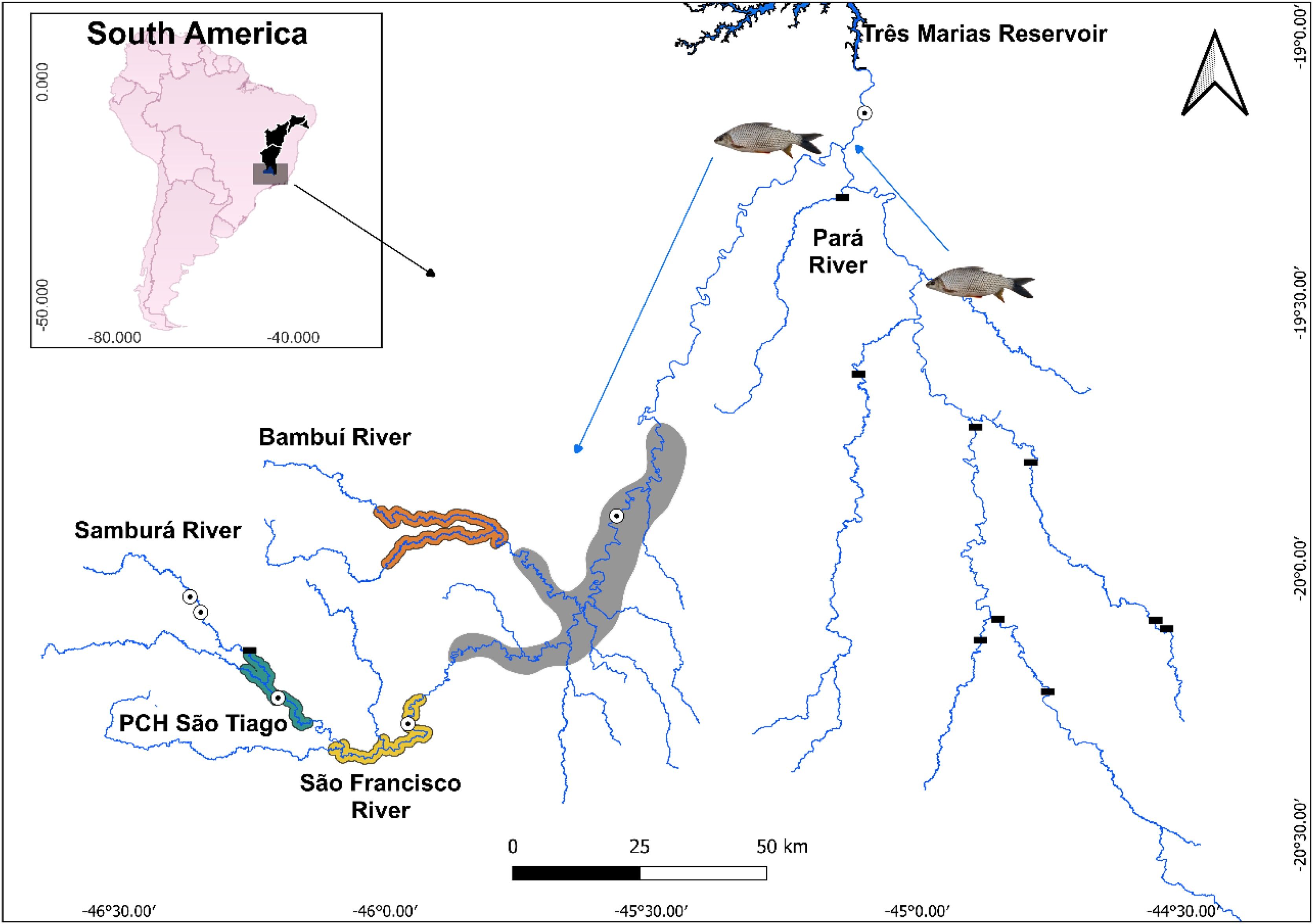
A practical caseTo examine this assumption, we focus on populations of pioa (Prochilodus costatus) inhabiting the remaining lotic remnant stretch of the upper São Francisco River, delimited downstream by the Três Marias Reservoir (Fig. 1), used here as a hydrological boundary rather than a reference for small hydropower impacts. This species is one of approximately seven long-distance migratory fishes in the basin, all widely distributed throughout it (Sato and Godinho, 2003). By feeding on detritus, Prochilodus species play a key role in nutrient cycling, transforming organic matter into biomass and acting as ecosystem engineers that rework river-bottom sediments, thereby facilitating periphyton growth (Flecker, 1996). In the upper São Francisco River, pioa has been studied for a decade at fine spatial scales using an integrative methodological framework rarely applied to Neotropical migratory fishes, providing a robust evidence base, which is uncommon for this group of fishes, for evaluating connectivity-dependent impacts.
Map of the upper São Francisco River basin showing planned hydropower plants (including small hydropower plants, PCH), represented as circles with a central dot, and hydropower plants already in operation, represented as filled black rectangles. Gray shading indicates the floodplain, and blue arrows indicate the upstream reproductive migrations of the Pioa (Prochilodus costatus; see photographs) toward its spawning sites: Samburá (teal), São Francisco (yellow), and Bambuí (orange). Inset: location of the São Francisco River basin (black) within South America. For interpretation of the references to colour in this figure legend, the reader is referred to the web version of this article.
Adult pioa feed year-round throughout much of the basin and migrate annually to reproduce exclusively in upper basin reaches, where rivers are smaller (Lopes et al., 2019; Peressin et al., 2025). Similar patterns have been documented for other migratory fish species within the basin (Godinho and Kynard, 2006; Peressin et al., 2024) and in other South American river basins (Godoy, 1967; Duque et al., 1998). It is worth highlighting that upstream migrations of pioa in the Pará River have not been observed, most likely because the river is already extensively regulated by operating hydropower plants (Lopes et al., 2018). As a result, its migratory fish populations now depend on the upper São Francisco to complete their reproductive migrations. Thus, the current spawning sites in the upper São Francisco are already the last remnant habitats sustaining these populations. Because spawning sites of these species are often located upstream in smaller rivers, they are more likely to coincide with areas targeted for small hydropower development. As a result, even projects with limited installed capacity may block access to critical reproductive habitats and compromise entire populations.
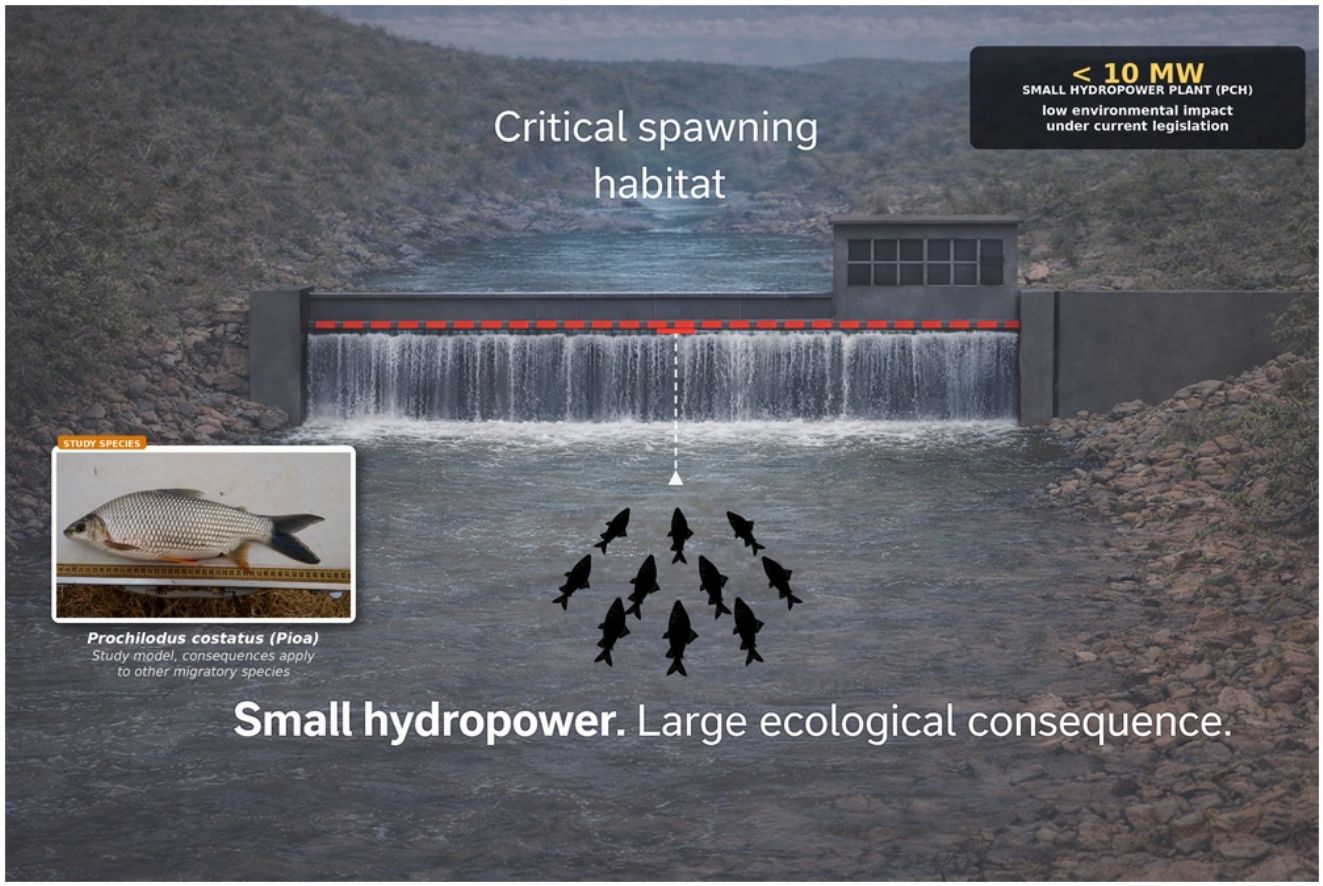
As a practical example, one of the population's primary spawning sites is the Samburá River, where three new small hydropower plants (PCHs) are planned. One of them, PCH São Tiago, would block access to and flood a substantial portion of one of the population's main spawning grounds (Lopes et al., 2025) (Fig. 1), despite an installed capacity of only 9 MW. Under current legislation, it could therefore be classified as a low-impact project and be eligible for licensing without an EIA, despite its potential to jeopardize reproduction for the entire population by blocking access to part of the few remaining spawning grounds.
Importantly, tributaries often represent the only remaining viable reproductive routes when the main channel has already been dammed, as documented across multiple basins (Godinho and Kynard, 2006; Silva et al., 2021). Smaller tributaries may also function as intermediate growth habitats for juveniles of migratory species (Moreira et al., 2023). In addition, individual fish exhibit high fidelity to both spawning grounds and feeding areas (Lopes et al., 2019; Peressin et al., 2025), which reduces the likelihood of establishing alternative reproductive routes after blockage of the original pathway.
Mitigation: why fish passage and stocking do not guarantee successful reproductionIncreasing fish passability across barriers through fishways and stocking programs are frequently presented as technical solutions capable of mitigating dam impacts on migratory fishes; these mitigation strategies are mandatory in some jurisdictions (e.g., Law 12,488/1997, state of Minas Gerais, Brazil). However, accumulated scientific evidence indicates that these measures rarely succeed in maintaining ecologically viable populations at the basin scale (Lennox et al., 2019). Even when upstream passage is successful, the migratory cycle may remain incomplete. For example, experiments at the Três Marias Hydropower Plant demonstrated that fish translocated from downstream reaches to the reservoir, simulating fish passage, or to upstream lotic stretches were unable to locate suitable spawning sites, ultimately failing to complete their natural migratory cycle (Lopes et al., 2021).
Even if adults reach spawning grounds and reproduce, the ecological cycle may still be interrupted. Egg and larval drift can be blocked by reservoirs (Pompeu et al., 2012), substantial mortality may occur in turbines affecting adults (Andrade et al., 2012), eggs, and larvae, and adults may be prevented from returning to feeding grounds (Pelicice et al., 2015). Thus, the existence of a fish passage system that enables some degree of local connectivity does not imply functional connectivity. Similarly, just as long-isolated and subsequently translocated fish may fail to recognize local environmental cues and complete reproduction (Lopes et al., 2021), stocking programs present significant limitations. Individuals produced in hatcheries rarely establish self-sustaining reproductive populations in natural environments (Agostinho et al., 2010). Additional risks include the introduction of pathogens and non-native species, as well as hybridization with local populations, leading to erosion of local adaptive capacity (Pelissoli et al., 2023; Agostinho et al., 2010).
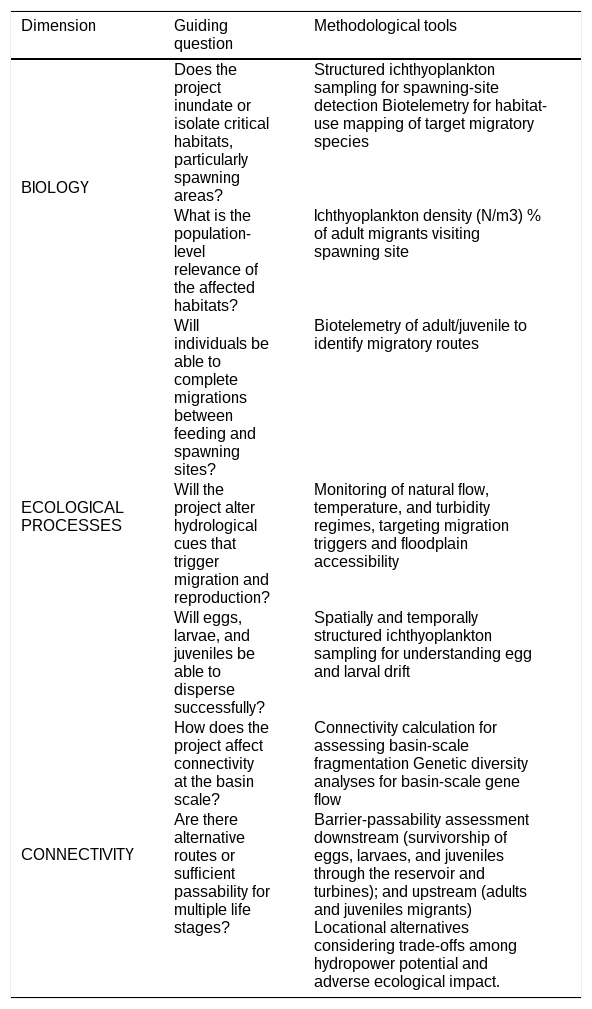
Recommended strategiesWe propose a multi-scale assessment framework (Table 1) to guide environmental impact evaluation and licensing of hydropower projects that block river systems, regardless of installed capacity. This framework is intended to support decision-making by environmental agencies, hydropower project stakeholders, and policymakers, while also informing non-governmental organizations and civil society engaged in licensing processes. Rather than relying on installed capacity as a proxy for impact, the framework integrates key dimensions of migratory fish ecology, requiring explicit evaluation of how projects affect critical habitats, movement pathways, and ecological processes necessary for population persistence. To implement this approach, we propose a set of guiding questions that should be addressed during environmental assessment and licensing. The multi-scale framework provides a conceptual and analytical basis for answering these questions, linking life-cycle stages to spatial scales and connectivity processes. Together, the framework and guiding questions provide a practical basis for identifying projects that pose disproportionate risks to migratory fish, even when classified as small-scale.
Multi-scale framework for assessing hydropower project impacts on migratory fish, with guiding questions for multi-scale assessment of hydropower impacts on migratory fish integrating life-cycle stages and basin-scale connectivity. Note: This framework applies only to long-distance migratory fish.
| Dimension | Guiding question | Methodological tools |
|---|---|---|
| BIOLOGY | Does the project inundate or isolate critical habitats, particularly spawning areas? | Structured ichthyoplankton sampling for spawning-site detection Biotelemetry for habitat-use mapping of target migratory species |
| What is the population-level relevance of the affected habitats? | Ichthyoplankton density (N/m3) % of adult migrants visiting spawning site | |
| ECOLOGICAL PROCESSES | Will individuals be able to complete migrations between feeding and spawning sites? | Biotelemetry of adult/juvenile to identify migratory routes |
| Will the project alter hydrological cues that trigger migration and reproduction? | Monitoring of natural flow, temperature, and turbidity regimes, targeting migration triggers and floodplain accessibility | |
| Will eggs, larvae, and juveniles be able to disperse successfully? | Spatially and temporally structured ichthyoplankton sampling for understanding egg and larval drift | |
| CONNECTIVITY | How does the project affect connectivity at the basin scale? | Connectivity calculation for assessing basin-scale fragmentation Genetic diversity analyses for basin-scale gene flow |
| Are there alternative routes or sufficient passability for multiple life stages? | Barrier-passability assessment downstream (survivorship of eggs, larvaes, and juveniles through the reservoir and turbines); and upstream (adults and juveniles migrants) Locational alternatives considering trade-offs among hydropower potential and adverse ecological impact. |
It is worth noting that this framework, as well as the information presented in Table 1, applies only to the connectivity dimension for long-distance migratory fish. Consequently, it may not be applicable to small rivers or streams where migratory species have already been extirpated or do not occur naturally. A low-impact result under this framework does not exempt the project from rigorous complementary assessments of resident/endemic taxa and local limnological dynamics.
Beyond site-specific dependencies required for migratory fish to complete the life cycle, project impacts on basin-scale connectivity must also be evaluated. The position of a dam within the river network can produce markedly different connectivity outcomes, even for projects with identical hydropower potential (Barbarossa and Schmitt, 2024). Following the approach proposed by Cote et al. (2009), connectivity indices should be calculated by accounting for existing and planned projects within the basin. This approach has the advantage of incorporating the cumulative effects of multiple dams, an aspect that remains largely overlooked in current hydropower impact assessments.
Within this context, maintaining free-flowing rivers with high conservation value should be considered a priority in hydropower planning and environmental licensing. Rivers with limited hydropower potential but critical importance for migratory fish should be explicitly designated for protection. For example, the Santo Antônio River, a tributary of the Doce River basin (Brazil), illustrates this contrast: although its upper course represents less than 7% of the basin’s hydropower potential, it harbors nearly all migratory species and threatened fish within the Doce River basin (Pompeu, 2012). In such cases, avoiding new barriers is more effective than attempting to mitigate their impact. Investing in the protection of self-sustaining populations through the maintenance of intact river systems with low hydropower potential is far more reliable than allocating resources to costly and often ineffective mitigation measures such as fish passage systems and stocking programs (Lopes et al., 2025).
ConclusionsThe association between adverse environmental impact and the size or type of hydropower projects can lead to severe and underestimated ecological consequences. Our synthesis shows that adverse impacts on migratory fish are primarily determined by life-cycle dependency and the position of barriers within the river network, rather than by installed capacity. Even comprehensive Environmental Impact Assessments (EIAs) often fail to capture these critical dimensions, while simplified licensing procedures are even less likely to identify high-risk projects. Therefore, policymakers and environmental agencies must incorporate habitat requirements, connectivity, and cumulative basin-scale effects into hydropower planning and licensing decisions, regardless of the size. Consequently, projects that threaten key spawning habitats used by a significant proportion of migratory populations should not be classified as low impact.
Declaration of Generative AI and AI-assisted technologies in the writing processDuring the preparation of this work the authors used ChatGPT (OpenAI) to assist with the visualization and design of the graphical abstract based on the authors’ conceptual instructions and for minor language and grammatical revision of the manuscript text. After using this tool, the authors reviewed and edited the output as needed and took full responsibility for the content of the published article.
The authors, Alexandre Peressin, Stephannie Fernandes, Ivo Gavião Prado, João de Magalhães Lopes, and Paulo Santos Pompeu, declare that they have no known competing financial interests or personal relationships that could have appeared to influence the work reported in this paper.
This work resulted from a project funded by the Companhia Energética de Minas Gerais/Agência Nacional de Energia Elétrica Research and Development Program (P&D 612). Paulo S. Pompeu received a research productivity grant from the Conselho Nacional de Desenvolvimento Científico e Tecnológico (CNPq nº 302328/2022–0). Alexandre Peressin received a doctoral scholarship from Fundação de Amparo à Pesquisa de Minas Gerais (FAPEMIG nº 11548/2018) and a postdoctoral fellowship from Fundação de Amparo à Pesquisa do Estado de São Paulo (FAPESP nº 2023/17041-3). We would also like to thank Professor Elizabeth P. Anderson for her valuable contribution in an early version of this manuscript.